


Millions of mostly disconnected websites have been findable thanks to search engines like Google, and this is how things have generally been for over 25 years. Google wasn’t the first, but they quickly became the best by incorporating relevance into their results. Google has become synonymous with finding answers as Kleenex is to tissues, Tupperware is to food storage, and Band-Aid is to bandages. However, for a company that has helped people find things for years, Google seems to have lost its way. This opens the door to competition in ways that weren’t possible before.
Has Google Become Its Own Worst Enemy?
Google’s dominance as a search engine has helped it generate many billions of dollars over the years, mostly from online advertising. Ads on their search engine, ads on YouTube, and ads on millions of other websites that target you before you even use Google now bring in over $200 billion annually. But just as Google dominates online search, online advertising dominates Google’s revenue stream. They’re trying to diversify into other products and services, such as cloud hosting and computing, but they still make over 80% of their revenue from advertising. It’s a precarious position since it’s based on market dominance going back two decades, and things do – and always will – change.
Google has constantly evolved to show you more ads in more places while making the ad space more expensive for advertisers. In 2022, the average CPC across all industries was $3.34 and the average CTR was 6.63% They will need the foresight to see that there’s a limit to how many ads a person can be shown before they stop being effective. It’s a win-win when you control both ends of the system, but more ads are never a good experience for the user, and people only have so much disposable income.
Google seems to be pushing its luck trying to make more ad revenue now while risking ad revenue in the future. Whether it be by making Google’s search results page more of an information hub than a list of helpful websites (which keeps you on google.com longer so you’ll be more likely to click an ad) or greatly increasing the number of ads being shown on YouTube in recent months. Operating in a way that is bound to result in a noticeably lower return for advertisers will cause them to pull back as their returns decrease. Average CPCs would begin to drop, and Google would enter a negative feedback loop due to too much self-cannibalization.
Who Could Catch Google?
A website that has been growing in popularity year-after-year with surprising consistency is Reddit. A Google Trends comparison of searches on Google for Twitter, Reddit, Instagram and TikTok starting in 2008 show when each became popular and when searches for each rose and fell over time. (Note: searches for a platform aren’t a measure of usage of the platform, but they can be indicative of growth potential.)
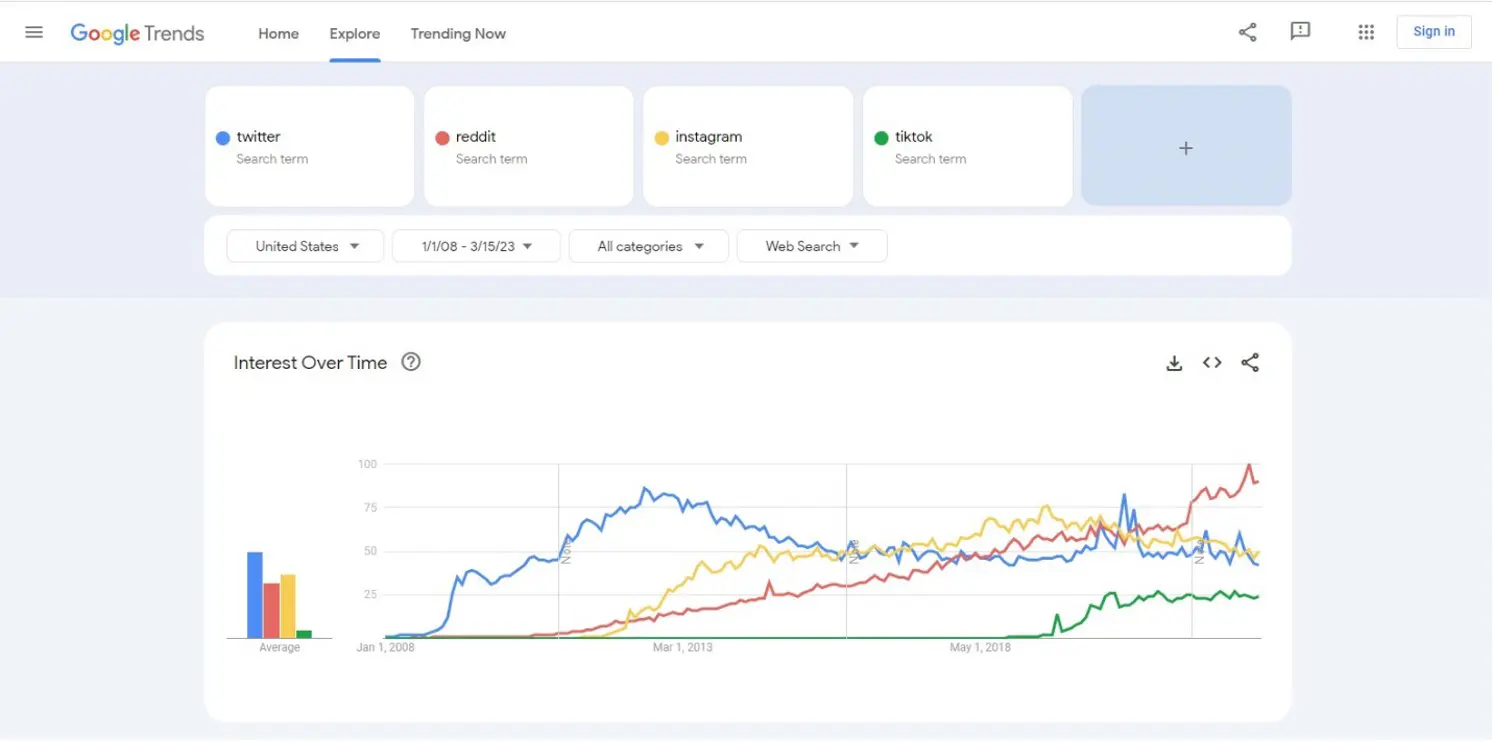
Reddit is a growing source of information, often by people looking to see how others have dealt with a particular situation. As Google becomes less helpful, Reddit will only become even more popular. It will never be a direct threat to Google, but anything that bleeds users away from Google in a non-negligible way is worth paying attention to.
ChatGPT, the artificial language bot, is another contender that could compete on the search engine stage. It flew past everyone at shocking speed with its next-generation capabilities that accepts queries in a conversational manner and delivers a response in a way that often goes above and beyond what a person could do. Other AI tools have been popping up for over a year now, but ChatGPT has already been disruptive. It has forced Microsoft to speed up AI implementation into Bing, and Google was forced to announce its own version (called “Bard”) before it was ready.
What Comes Next?
AI-powered tools will start being incorporated into your email, office programs, phone apps, and who knows what else. But what about searching the internet? Search engines are the gatekeepers to content, but they don’t own the content itself. Will Google provide a better user experience using these recent AI advancements? Will Microsoft catch up with AI part of Bing search? Or will ChatGPT morph into something that can find everything Google and Bing can and more?
Things are evolving rapidly and what happens next is unclear. Large corporations move very slowly, and Google has shown an ability to overreact in the wrong ways before. Google+ was introduced as a response to the popularity of Facebook and incorporated into everything. Then Google bet on tablets for the next iteration of Google Ads and smartphones got popular instead.
While the short-term future is uncertain, paying attention to all the moving pieces will be critical. The story of online search is likely to be quite different before the end of 2023.